

Most parents discover fairly quickly that music does something to a fussy baby. It's one of those pieces of knowledge passed down through generations, embedded in cultures across the world, and backed up by the exhausted experience of new parents everywhere. But what's actually happening when you switch on a musical mobile and watch a restless newborn slowly quiet down?
The answer involves auditory neuroscience, the physiology of stress, the structure of lullabies across human cultures, and how a developing brain responds to rhythmic, predictable sound. It's more interesting than most people expect - and it changes the way you think about what a good musical mobile is actually doing.
Atbrowse practical nursery accessories, we think a lot about the developmental role of the products we offer. Music is one area where the science is particularly compelling, and understanding it helps explain why some musical mobiles are more effective than others - and what to look for when making a choice for your nursery.
The Auditory System: Active Long Before Birth
Here's something that often surprises new parents: a baby's hearing is one of the most developed senses at birth. While vision is quite limited in those first weeks (blurry, low-contrast, short-range), the auditory system has been functional and developing since around 20 weeks of gestation. By the third trimester, fetuses respond to sound, startle at loud noises, and show a measurable preference for their mother's voice - which they've been hearing through the womb for months.
This means a newborn arrives in the world already acoustically experienced to a degree. They recognize the rhythm and melody of their mother's voice. They've been processing the muffled sounds of the outside world. The auditory cortex is primed and receptive in a way that no other sensory system quite matches at this stage.
This auditory readiness is part of why sound is such a powerful tool for settling newborns. It's not that music is a trick that distracts them. It's that the auditory system is already one of the primary ways they receive and process meaningful information about the world around them.
What Research Says About Lullabies and Physiological Calm
The calming effect of lullabies isn't just anecdotal. It's been measured. In a study published in Nature Human Behaviour and conducted at Harvard's Music Lab, 144 American infants were played recordings of lullabies and non-lullaby songs from foreign cultures - music the infants had never heard before, in languages their families didn't speak. The results were consistent throughout the first year of life: infants showed measurably reduced heart rate, lower pupil dilation, and attenuated electrodermal activity (a physiological measure of arousal) in response to the lullabies compared to the matched non-lullaby songs.
The fact that unfamiliar foreign lullabies produced these effects is significant. It means the calming response wasn't purely about familiarity or learned association. There's something in the acoustic structure of lullabies themselves - their tempo, their melodic contour, their rhythmic regularity - that consistently signals safety and calm to the infant brain.
This aligns with a broader body of research showing that lullabies and gentle music appear to activate the parasympathetic nervous system, the branch of the autonomic nervous system responsible for rest and recovery. Heart rate slows. Breathing deepens. Muscle tension decreases. These are not subtle or imagined effects. They're measurable physiological changes.
The Entrainment Effect: How Tempo Shapes a Baby's Heart Rate
One of the more fascinating mechanisms behind musical calming is what music researchers call the entrainment effect. Traditional lullabies across virtually all human cultures share a strikingly consistent tempo: roughly 60 to 80 beats per minute. This range isn't arbitrary. It closely mirrors the resting heart rate of a relaxed adult.
When a baby's faster heart rate is exposed to music in this tempo range over time, evidence suggests that the heart rate can gradually synchronize with the slower pace of the music. The body essentially follows the beat downward toward a calmer physiological state. Research in music psychology indicates this response can include slower, deeper breathing, decreased muscle tension, and a shift in brain wave patterns toward states associated with drowsiness and sleep onset.
This is one reason why the tempo of music in a mobile matters considerably. Upbeat, faster-tempo music might catch attention and produce alerting responses - fine for playful engagement, but counterproductive if the goal is settling a baby for sleep. Gentle lullabies and slow melodies, delivered at that 60-80 BPM range, work with the body's natural physiology rather than against it.
Ourmobile options with gentle music and motion is designed with exactly this kind of calm, gentle music delivery in mind - putting control in the parent's hands to adjust what the baby hears and when. Similarly, oursensory hanging toys for supervised play incorporates white noise as an additional calming option, which works through a different but complementary physiological mechanism.
White Noise vs. Music: Two Different Calming Pathways
It's worth understanding the difference between how lullaby-style music and white noise calm infants, because they work through genuinely different mechanisms.
Lullabies and melodic music engage the auditory cortex actively. The brain processes rhythm, melody, and pattern. It builds predictive expectations - it learns what note or phrase comes next - and the confirmation of those expectations is itself neurologically reassuring. This active engagement is part of what makes music so effective even for infants who are already somewhat distressed.
White noise works differently. It masks the unpredictable sounds of the surrounding environment - the creaking house, the traffic outside, the voices in another room - by providing a consistent, non-meaningful acoustic backdrop. For a newborn whose nervous system is easily startled by sudden sounds, this masking effect reduces the sensory load and allows the parasympathetic response to engage more easily.
Both have a role in a nursery setting, and the most versatile musical mobiles offer options for both. The choice between them isn't really one or the other - it's about understanding what your baby needs in a given moment.
Music and the Developing Brain: Beyond Relaxation
The benefits of musical exposure in early infancy extend well beyond helping a baby settle. Research from the Institute for Learning and Brain Sciences at the University of Washington, published in the Proceedings of the National Academy of Sciences, found that babies who experienced rhythmic musical play sessions showed stronger brain responses to disruptions in both musical and speech rhythm than babies in a control group. The researchers noted this suggests that early musical experience may improve an infant's ability to detect and predict rhythmic patterns in sound - a capacity that is directly linked to language development.
When a musical mobile plays a simple, repetitive lullaby, the auditory cortex processes rhythm and melody. The same brain regions that map musical rhythm will later be used to process the rhythm of speech - the cadences and patterns that help a baby begin to distinguish one word from another. This connection between musical rhythm and speech processing is one reason why consistent, gentle musical exposure during infancy is considered supportive rather than merely pleasant.
The predictability dimension matters here too. When a mobile plays the same melody repeatedly, the infant brain builds an internal template of what to expect. Neuroscientists refer to this as schema formation. Each time the familiar melody begins, the brain recognizes it, anticipates what's coming next, and experiences the confirmation of that anticipation as a form of cognitive comfort. Predictability, in the neurological sense, signals a safe and ordered world.
This is part of why we've written about the broader role of sensory consistency in infant development - including in our post on what occupational therapists say about baby mobiles and sensory development, which touches on how predictable sensory input across multiple channels supports regulation in young infants.
Volume and Sound Safety: What Often Gets Overlooked
One aspect of musical mobile design that doesn't get enough attention is volume. A newborn's hearing is sensitive. Sounds that seem perfectly reasonable to an adult can be overstimulating to an infant's auditory system, particularly in an enclosed crib environment where there's no distance to dampen the effect.
Most developmental and pediatric guidelines suggest keeping nursery music and mobile sound at around 50 to 65 decibels maximum - roughly the level of a quiet conversation or soft background music. Some sources suggest that mobile music experienced directly in the crib should sit toward the lower end of that range. High volume music in a crib setting can overstimulate rather than calm, triggering the same stress hormone response that fast motion or visual overload produces.
Mobiles that offer volume control - like those in ourbrowse crib mobiles by feature and style - give parents the ability to calibrate the audio environment to what's actually appropriate for their specific baby and setting. This matters more than it might seem, because the right volume for settling a baby during a nap is different from the volume needed to capture attention during an alert, wakeful play period.
The Multi-Sensory Advantage: When Music and Motion Work Together
One of the things a well-designed musical mobile does that a simple speaker or music player cannot is combine gentle sound with slow, rhythmic motion at the same time. This multi-sensory combination turns out to be particularly effective.
The visual system is processing the gentle rotation of hanging elements. The vestibular system is registering predictable, low-intensity movement cues. The auditory system is receiving rhythmic, gentle melodic input. When all three systems receive consistent, calm, predictable stimulation simultaneously, the cumulative effect on the nervous system is greater than any one channel alone.
This is partly why parents often notice that a musical mobile works better as a settling tool than music alone, or visual stimulation alone. The brain is receiving a coordinated, cross-sensory signal that the environment is calm and safe. The parasympathetic response is triggered through multiple pathways at once.
We explore some of these multi-sensory dynamics in our post on whether cot mobiles genuinely support infant sleep and settling, which looks at the evidence behind using mobiles as part of a broader bedtime routine.
What to Look For in a Musical Mobile
Given everything above, a few design considerations stand out when choosing a musical mobile:
Gentle, slow-tempo music is preferable to upbeat or fast-tempo sound for settling purposes. Lullabies and simple melodies in the 60-80 BPM range align best with the physiological calming mechanisms described above.
Volume control is important. Fixed-volume mobiles offer no flexibility for different environments or different times of day. Being able to lower the sound for a light sleeper or raise it slightly for a noisy household is a practical necessity.
Auto-shutoff or timer functions help prevent the mobile from running through deep sleep, which is preferable from both a safety and a developmental standpoint.
White noise as an additional option gives parents versatility for babies who respond better to masking sound than to melody at certain times.
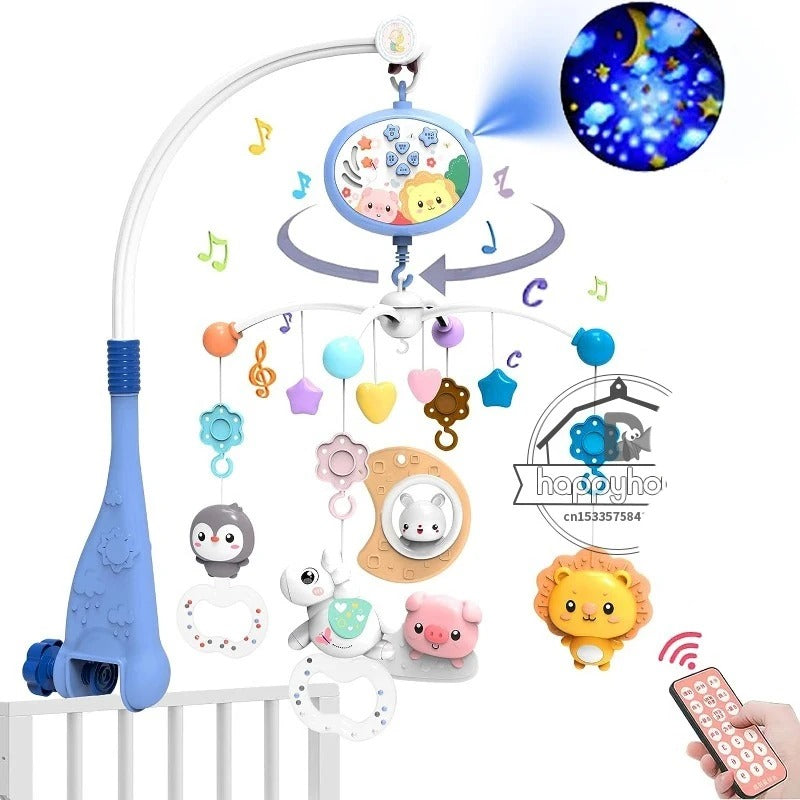
Our baby crib mobile with lights, music, and projection for infants and the broaderchoose a mobile arm for your crib cover a range of configurations suited to different nursery setups and parental preferences.
For families building a sleep routine around their mobile, our post on how cot mobiles fit into bedtime routines for infants offers some practical guidance on timing, consistency, and what to expect as the baby grows.

Music Has Always Been Part of How We Care for Babies
There's a reason lullabies exist in every known human culture. This isn't a modern parenting trend or a product category built around marketing. The use of gentle, rhythmic music to soothe infants appears to be one of the oldest and most universal caregiving practices in human history - and the neuroscience is now beginning to explain why it works in physiological detail.
A musical cot mobile puts that ancient, effective tool in a consistent, hands-free format that works for the nursery. When the design is thoughtful - the right tempo, the right volume, combined with gentle motion - it delivers genuinely meaningful auditory support during one of the most developmentally significant periods of your child's life.
Baby Cot Mobile designs and curates products with this understanding in mind. If you'd like help choosing a musical mobile suited to your baby's age, your nursery setup, or your sleep routine goals, we'd be glad to hear from you. Reach out to our team here and we'll help you find the right fit.
Frequently Asked Questions
Does music from a baby mobile actually help infants relax?
Yes, research supports this. A study published in Nature Human Behaviour found that infants consistently showed measurably reduced heart rate, lower pupil dilation, and attenuated physiological arousal in response to lullabies - including unfamiliar ones in foreign languages. The calming response appears to be related to the acoustic structure of lullabies themselves, not just learned familiarity.
What type of music is best for calming a baby?
Slow-tempo music in the 60-80 BPM range is generally considered most effective for calming infants. This tempo closely mirrors adult resting heart rate and may encourage a process called entrainment, where the baby's heart rate gradually follows the music's slower pace. Simple, repetitive lullabies and gentle melodies are preferable to upbeat or complex music for settling purposes.
Does a musical mobile help babies sleep?
Musical mobiles may support the transition to sleep by engaging the parasympathetic nervous system through gentle, rhythmic sound combined with slow visual motion. They are most useful as part of a consistent pre-sleep routine rather than as a continuous sleep aid. Most safety guidance recommends using an auto-shutoff function so the mobile isn't running through deep sleep phases.
What volume should a baby mobile music play at?
Most developmental guidelines suggest keeping nursery music at around 50 to 65 decibels - roughly the level of a quiet conversation. In an enclosed crib environment, staying toward the lower end of that range is advisable. Sounds that seem quiet to adults can feel more intense to a newborn's sensitive auditory system, particularly when heard at close range.
Is white noise or music better for calming a newborn?
They work through different mechanisms. Music, particularly lullabies, actively engages the auditory cortex and activates the parasympathetic calming response through pattern and rhythm processing. White noise masks unpredictable environmental sounds that might startle a baby, reducing sensory load without requiring active auditory processing. Both can be effective, and many parents find one works better than the other for their specific baby. Mobiles that offer both options provide the most flexibility.
Does listening to music benefit infant brain development?
Research suggests yes, within appropriate limits. A study from the University of Washington published in the Proceedings of the National Academy of Sciences found that infants who experienced rhythmic musical exposure showed stronger brain responses to patterns in both music and speech. Early musical experience appears to support the auditory pattern recognition skills that are foundational to language development.
When should I stop using a musical mobile?
Most safety guidelines recommend removing crib mobiles once a baby can push up on hands and knees, typically around 4 to 5 months, as the risk of the baby reaching and pulling the mobile increases. The music function itself can often continue to be used separately, repositioned out of reach, as part of a sleep routine for older babies and toddlers.